
Native AI Environment
Operates with Ubuntu Linux and NVIDIA DGX OS, providing immediate access to the entire NVIDIA AI Software Stack (NIM, Blueprints) for seamless compatibility with PyTorch, Jupyter, and Ollama.
$0.00
Your cart is empty
Join our community for exclusive offers and updates.
No, thank you. I'll pay full price.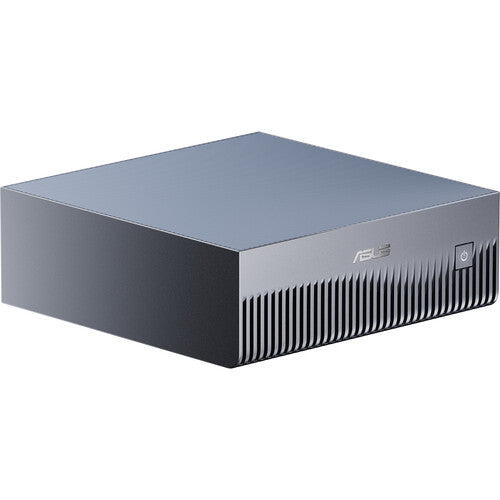
OURBIZ-US Shop
Storage: 1TB
The ASUS Ascent GX10 redefines the limits of local computing by condensing the massive power of a server into a tiny desktop chassis. Equipped with the innovative NVIDIA GB10 Grace Blackwell superchip, which combines a 20-core ARM CPU and a powerful integrated NVIDIA GPU, this workstation can deliver up to 1 petaFLOP of AI performance. It is the ultimate scalable tool for prototyping, fine-tuning massive models, and real-time local inference.
Expressly designed for the demands of modern Artificial Intelligence development, the Ascent GX10 integrates 128 GB of LPDDR5x unified memory and a fast 1 TB NVMe SSD for seamless handling of large data volumes. In addition, its advanced QuietFlow Cooling thermal system with triple fan and dual vapor chamber ensures stable temperatures under extreme loads. With next-generation networking technologies such as Wi-Fi 7, 10 Gb Ethernet, and an NVIDIA ConnectX-7 interface for clustering devices, the scalability of your projects will be limitless.
Experience enterprise-grade performance with a unified architecture that links a 20-core ARM v9.2-A CPU and the advanced Blackwell GPU. Achieve up to 1 petaFLOP of FP4 compute to drastically accelerate your AI workflows.
Eliminate bottlenecks once and for all. Its 128 GB of coherent LPDDR5x RAM allows the CPU and GPU to share the same data block at very high speed, facilitating the training and handling of Large Language Models (LLMs).
Maintain maximum performance in a tiny chassis thanks to an innovative thermal design featuring three ultra-quiet fans and a high-efficiency dual vapor chamber heatsink.
Scale your projects by linking multiple systems using its NVIDIA ConnectX-7 module. Additionally, instantly synchronize databases with its 10G Ethernet LAN port and the revolutionary Wi-Fi 7 wireless standard.
The ASUS Ascent GX10 comes factory-prepared with an optimized connectivity and software environment so developers can start creating solutions from day one.
Operates with Ubuntu Linux and NVIDIA DGX OS, providing immediate access to the entire NVIDIA AI Software Stack (NIM, Blueprints) for seamless compatibility with PyTorch, Jupyter, and Ollama.
Full connectivity with three USB-C 3.2 Gen 2x2 ports at 20 Gbps (DisplayPort 2.1 compatible), plus an additional port dedicated to power delivery (PD IN).
Includes a 1 TB M.2 NVMe PCIe 4.0 SSD to ensure ultra-fast read and write times when processing dense datasets and machine learning training.
| Operating System | Ubuntu Linux / NVIDIA DGX OS |
|---|---|
| Processor (CPU) | 20-core ARM v9.2-A (Up to 3.25 GHz Cortex A725 and 3.8 GHz Cortex X925) |
| Graphics (GPU) | NVIDIA Blackwell GPU (Integrated) with up to 1 petaFLOP AI |
| Memory | 128 GB integrated unified LPDDR5x (Non-expandable) |
| Storage | 1 TB M.2 NVMe PCIe 4.0 SSD |
| Rear Ports | 3x USB 3.2 Gen 2x2 Type-C (Alt Mode / DP 2.1 support), 1x USB 3.2 Gen 2x2 Type-C (Power Delivery In 180W), 1x HDMI 2.1a, 1x RJ45 LAN (10 GbE), 1x NVIDIA ConnectX-7 SmartNIC |
| Wireless Connectivity | Wi-Fi 7 (802.11be) and Bluetooth 5.4 |
| Power Supply | 240 W USB-C adapter |
| Dimensions | 150 x 150 x 51 mm |
| Weight | 1.48 kg |
No. Being oriented towards data science and neural networks, the GX10 comes factory-equipped with Ubuntu Linux and NVIDIA DGX OS, ensuring a robust and optimized environment for AI software.
No. Its 128 GB of LPDDR5x memory is implemented as a "Unified Memory" architecture and is soldered directly onto the system (SoC). This design is key to achieving the massive bandwidth simultaneously shared by the CPU and GPU.
The computer is powered by the included 240W power adapter. This adapter efficiently connects to the device via a rear USB Type-C port specially dedicated to power input (Power Delivery 3.1).
